
Let’s talk about your book!

Simply fill out the form below to select a date & time for your no obligation consultation
to see if self-publishing with Outskirts Press is right for you.

By providing a mobile number, you grant Outskirts Press consent to send text message communications for promotional purposes. Consent is not a condition of purchase. Message frequency varies and data rates may apply. Reply "STOP" to unsubscribe at any time. We do not share your information with anyone (see our Privacy Policy).

This site is protected by reCAPTCHA and the Google Privacy Policy and Terms of Service apply.

Self-Publishing News

Self-Publishing News, Trends & Insights

Stay informed with publishing news, industry trends, author insights, and updates from the evolving world of self-publishing.

Top Consumer Reviews

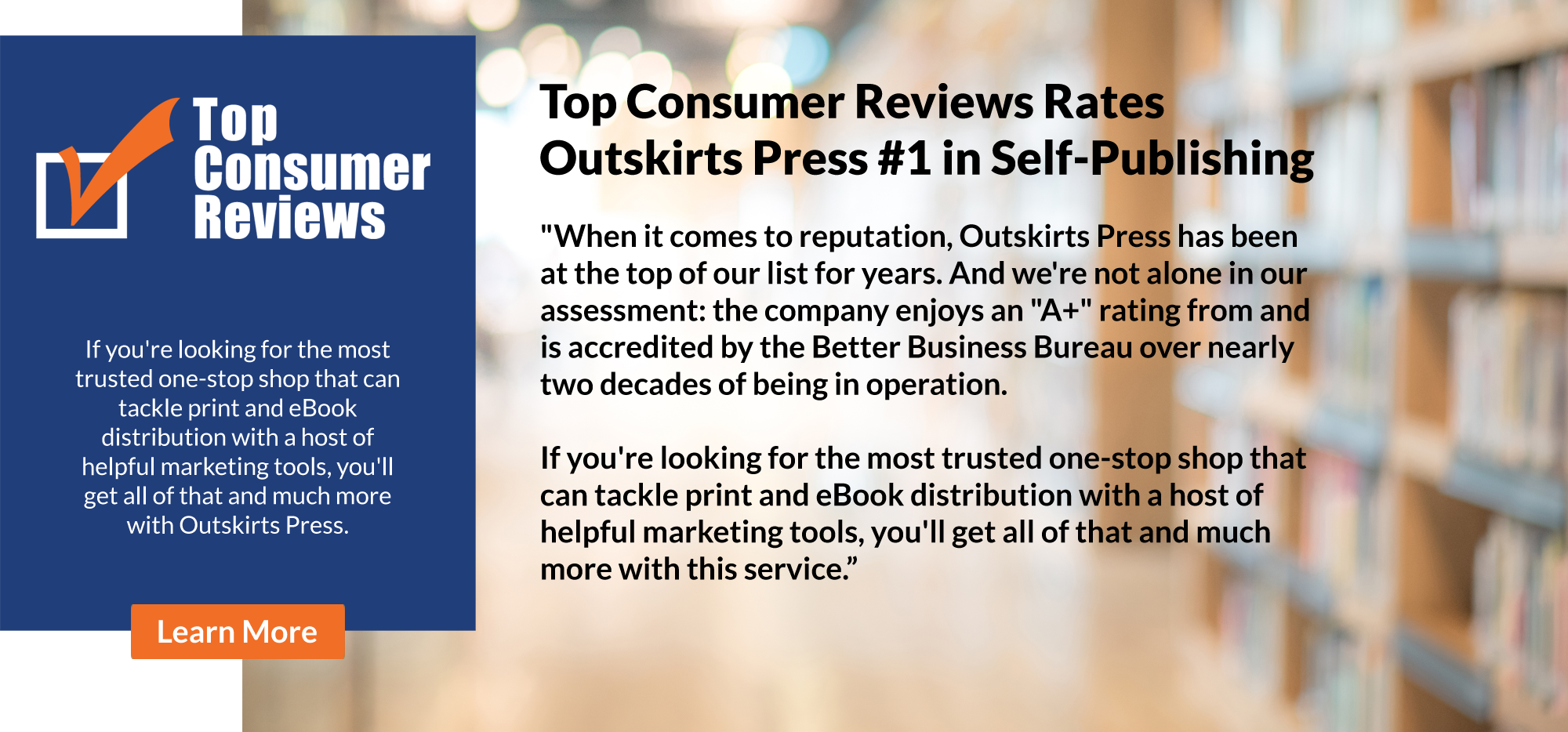
Outskirts Press Voted #1 in Self-Publishing by Top Consumer Reviews — 10 Years in a Row

For the tenth consecutive year, independent review site Top Consumer Reviews has ranked Outskirts Press #1 among self-publishing services.

The recognition reflects Outskirts Press' comprehensive publishing services, personalized author support, flexible publishing options, and author-friendly approach to professional self-publishing.

For authors deciding how and where to publish, a decade at the top of an independent review site's rankings offers another reason to consider Outskirts Press for bringing a book to market.

Read the Full Story
book marketing, holiday marketing, marketing, Publishing Tips, self publishing news

National Young Readers Week and How Authors Can Inspire Lifelong Reading

woman enjoying reading a book by a cozy window at home on windowsill - reading stock pictures, royalty-free photos & images

National Young Readers Week draws attention to a simple but important goal: helping children build a lasting relationship with books. Independent authors contribute to that goal when they create stories and informational books that respect young readers, reflect their curiosity, and give them a reason to keep turning pages.


Writing for children is not a reduced version of writing for adults. Young readers notice when a story talks down to them, rushes its emotional logic, or uses a lesson as a substitute for a satisfying reading experience. Authors can support literacy most effectively by creating books that are clear, engaging, age-appropriate, and rewarding to revisit.


Write for a Defined Reading Stage

A child’s age and reading stage influence nearly every creative decision. Picture books depend heavily on read-aloud rhythm and visual storytelling. Early readers need controlled complexity and supportive repetition. Chapter books offer more independence while maintaining accessible plots, and middle-grade books can explore deeper themes through the perspective of young characters.


Choose an age range before final revision and study recently published books for that audience. Notice typical word counts, chapter lengths, vocabulary, page design, and the relationship between text and images. These observations should guide the manuscript without forcing every book into the same mold.


Create Momentum Without Losing Clarity

Young readers need a clear reason to continue. Establish the central character, desire, question, or problem early, then let each scene create a meaningful next step. Explanations should arrive when the reader needs them. Long introductions and repeated background information can weaken curiosity before the story gains momentum.


Clarity does not require flat language. Specific verbs, concrete details, humor, surprise, and emotional honesty make a book vivid. Read passages aloud and listen for sentences that feel difficult to say, scenes that stall, or dialogue that sounds more like an adult explaining a lesson than a child responding to the moment.


Invite Children to See Themselves and Others

Books can affirm a child’s familiar world and open a window onto lives beyond it. Thoughtful characters have interests, flaws, relationships, and agency. They should not exist only to represent a message. When writing outside your own experience, research carefully, seek informed feedback, and revise details that feel generalized or unearned.


Representation also includes the range of family structures, abilities, communities, interests, and ways children learn. Specificity makes a story believable. It can help a reader feel recognized while giving another reader a respectful introduction to a different experience.


Support the Adults Who Connect Books With Children

Children often discover books through parents, caregivers, teachers, librarians, and booksellers. Make it easy for those adults to understand the book’s audience and value. A clear description should identify the age range, subject, tone, and reading experience without making promises the book cannot support.


Helpful supplemental materials can extend the relationship. A short discussion guide, activity page, classroom prompt, pronunciation guide, or list of related resources may give adults a practical way to use the book. Keep these materials focused and connected to the actual story rather than turning them into a generic worksheet.


Plan Meaningful Young Reader Outreach
Author visits and read-aloud events work best when they are interactive and suited to the group’s attention span. Prepare a brief introduction, a strong excerpt, and one or two questions that invite participation. For older children, discuss a writing decision, research discovery, or revision challenge. This shows that books are made through choices and persistence.


When sharing photos or comments from events, protect children’s privacy and follow the host organization’s policies. Build relationships with schools and libraries by being reliable, prepared, and clear about what you can offer. A good event should serve the young readers first; promotion follows naturally when the experience is worthwhile.


Build a Catalog Readers Can Grow With
National Young Readers Week can prompt authors to think beyond a single launch. Consider how future books might serve the same age group, continue a series, explore related subjects, or meet readers at a later stage. Consistent quality and audience focus make it easier for families and educators to recommend an author’s work.


A lifelong reader may begin with one memorable book at the right moment. By writing with respect, producing the book professionally, and creating thoughtful ways for adults and children to engage with it, independent authors can strengthen reader relationships that last far beyond this week.


Outskirts Press 
Where gratitude meets great publishing. 

Connect with a Publishing Consultant today to learn how Outskirts Press can help YOU publish YOUR masterpiece:

Outskirts Press stands behind our book printing and design services with the best 100% satisfaction guarantee in the self-publishing industry. Start publishing today.


Click above to watch the video. New authors, click here for your free publishing kit.

Amazon Featured Book-of-the-Week

Amazon Featured Book-of-the-Week “Potty Mouths” by John Vanis

Ever wonder if your baby could talk?

They would probably speak the brutal truth- “Where’s the DAMN bottle?” to “Wipe my ASS!”

Potty Mouths: The shit I would say if I could talk is not your ordinary children’s book. It is a laugh-out-loud look at early parenthood through the most chaotic narrator imaginable – a newborn with zero filter and a full arsenal of profanity. This adult-humor picture book flips the script on traditional baby stories, delivering sharp satire, raw honesty, and the kind of exaggerated inner monologue every exhausted parent has secretly imagined.

Packed with outrageous baby commentary, over-the-top rants, and brutally funny observations about feeding, crying, sleeping, and surviving the newborn stage, Potty Mouths blends parenting humor, satire, and illustrated comedy into a fast, punchy read. Each page channels the voice of a tiny tyrant who’s hungry, confused, overstimulated, and absolutely done with everyone’s nonsense – making it perfect for parents who appreciate bold jokes and aren’t afraid of a little (okay, a lot of) profanity.

This book isn’t for kids – it’s for the grown-ups who need a break, a laugh, and a reminder that parenting is messy, ridiculous, and sometimes best handled with humor.

If you’ve ever wondered what your baby really thinks, this book gives you the unfiltered version – and it’s gloriously chaotic.


Want to see your book featured as an Amazon Book-of-the-Week? Click here.

Have you written a book that you’d like to publish?

Connect with a Publishing Consultant today to learn how Outskirts Press can help YOU publish YOUR masterpiece:

Outskirts Press stands behind our book printing and design services with the best 100% satisfaction guarantee in the self-publishing industry. Start publishing today.

Click above to watch the video. New authors, click here for your free publishing kit.

book marketing, holiday marketing, marketing, Publishing Tips, self publishing news

National Nonfiction Day: How to Self-Publish Practically

couple reading books on living room sofa - nonfiction books stock illustrations

National Nonfiction Day recognizes books that explain, teach, document, question, and preserve real experience. For independent authors, nonfiction offers a direct way to share knowledge with readers who are actively looking for an answer, a method, a history, or a new perspective.


A useful nonfiction manuscript combines authority with accessibility. Readers need to understand why the subject matters, trust the author’s handling of the material, and find the information easy to navigate. That requires careful organization before publication and a clear plan for design, distribution, and marketing afterward.


Define the Reader’s Main Need
Begin by stating the central promise of the book in one sentence. What will readers understand, do, or see differently after finishing it? A focused promise helps an author decide what belongs in the manuscript and what should be removed, saved for another project, or offered as supplemental material.


The intended audience should be equally specific. A business guide for first-time managers needs different examples and terminology from a book written for experienced executives. A local history aimed at residents may provide more background than one written for specialists. Knowing the reader shapes tone, chapter order, definitions, and the amount of supporting evidence required.


Build a Structure Readers Can Follow
Nonfiction readers often move through a book selectively. Clear chapter titles, descriptive subheadings, consistent terminology, and a logical sequence help them locate and apply information. Each chapter should have a distinct purpose and should advance the book’s main promise rather than repeating it in new words.


Consider the most useful organizing principle for the subject. A process may work best in sequential steps, a history in chronological order, and a reference book by topic. Memoir-based nonfiction may follow a narrative arc while pausing to explain broader lessons. The right structure reduces reader effort and makes the author’s expertise easier to recognize.


Strengthen Accuracy and Credibility
Review every factual claim, quotation, name, date, and source before the manuscript enters production. Keep a consistent citation method when the subject calls for notes or a bibliography. Obtain permission for copyrighted material when necessary, and distinguish personal experience from conclusions that require broader evidence.
Professional editing is valuable because it addresses both clarity and consistency. An editor can identify gaps in explanation, abrupt transitions, repeated points, and language that assumes too much background knowledge. Copyediting can then correct grammar, usage, and style so the reader can focus on the content.


Package the Book for Its Market

Nonfiction cover design should communicate the subject and level of authority without becoming crowded. The title, subtitle, and back-cover description must work together to tell potential readers what the book is about and why it is relevant to them. Interior design should support tables, lists, notes, images, and other elements without disrupting the reading flow.


Marketing begins with the same reader need that shaped the manuscript. Articles, interviews, workshops, newsletters, and short educational posts can each demonstrate the book’s value. An author does not need to explain the entire book in every message. A focused insight can lead an interested reader to the fuller treatment in the book.


Use a One Click Package to Coordinate Publication

A nonfiction project may require editing, custom design, multiple formats, distribution, and targeted marketing support. Coordinating those services individually can be time-consuming, especially for an author publishing for the first time.


Outskirts Press offers a One Click Nonfiction Publishing package within its black-and-white publishing and marketing suites. The bundled path is intended to organize professional services around nonfiction authors so they can move from manuscript to publication with a clearer process. Review the current inclusions and confirm that the package fits your book’s length, images, research apparatus, format, and promotional goals.


The best publishing choice is the one that fits the manuscript and the author’s objectives. Prepare a list of must-have features and questions before speaking with a consultant. That preparation makes it easier to compare options and understand where additional services may be useful.


Make the Book Useful for the Long Term

National Nonfiction Day is an ideal time to evaluate whether your manuscript is ready to serve its reader. Clarify the promise, test the structure, verify the facts, and plan how the finished book will reach the people who need it. These steps build trust, and trust is central to a lasting nonfiction author platform.


A carefully produced nonfiction book can support speaking, teaching, consulting, community work, or a broader catalog of related titles. When the book remains focused on a real reader need and is supported by a professional publishing plan, it can continue creating value well beyond its release date.


Outskirts Press 
Where gratitude meets great publishing. 

Connect with a Publishing Consultant today to learn how Outskirts Press can help YOU publish YOUR masterpiece:

Outskirts Press stands behind our book printing and design services with the best 100% satisfaction guarantee in the self-publishing industry. Start publishing today.


Click above to watch the video. New authors, click here for your free publishing kit.