



Teamwork in Ten Days

Building Successful Teams in the Arts, Sports, Business, and Government

by Thomas Charles Belanger
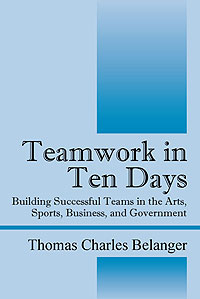
Teamwork in Ten Days
Pinterest

Teamwork in Ten Days

Building Successful Teams in the Arts, Sports, Business, and Government

by Thomas Charles Belanger

Published Dec 28, 2011
233 Pages
6 x 9 Black & White Paperback
Genre: SELF-HELP / General


    Find eBook/audiobook editions or buy the paperback or hardback at:

  • Looking for Kindle/Audio editions? Browse Amazon for all formats.
    Searching for the Nook edition? Browse Barnes & Noble.
 

Book Details

Teamwork in Ten Days

Be the teammate EVERYONE wants on their team! Keys to making your team successful: • 3 ways to assess yourself and your team’s strengths and weaknesses • 20 Characteristics of Successful Teams from 4 different perspectives • 400 ways to be a better teammate • Action planning for the next ten days and beyond! Teamwork in Ten Days captures the essence of what it takes to be a winner in the game of life. Tom combines the philosophies and practices of the greatest coaches and athletes with their equivalents in the fields of music, theatre, government, and business. Togo Palazzi (Former champion with the Boston Celtics.)


Book Excerpt

14. How to Increase Synergy On Your Team Drugs and alcohol, when combined, have a synergistic effect on our bodies. For example, when we drive a car under the influence of drugs and alcohol at the same time, our thinking may be impaired by a multiple of five to ten times the impairment of either one! Synergy is related to cohesion and collective intelligence. The sum of team effort is GREATER than the sum of the efforts of individuals. For most teams, the greater the synergy, the greater the team’s success! The Beatles certainly had synergy. When you combine the efforts of a cohesive team, those combined efforts can accomplish considerably more than a team whose individuals are working haphazardly. Teams that optimize their collective intelligence are more successful. This does not mean that the best teams have the highest average individual intelligence, nor one or two brilliant members. It means that teams should try to develop the team dynamics in which their COMBINED EFFORT demonstrates the most optimal use of their combined brainpower. Research continues on this type of intelligence at MIT’s Center for Collective Intelligence, and at Carnegie Melon University. When appropriate, ask your leaders to be careful not to inadvertently reduce synergy on your team. Sometimes, when a deadline approaches, it may be felt that time can be saved by “throwing more people at it.” Beware! This may actually add more delays because it will take time to orient the new people to the task and the team, and develop synergy. Their work will also need to be coordinated with the work of other people! To increase synergy on your team: • Ask for, and be open to new ideas and possibilities. • Encourage, and participate in a non-critical, free-flow of ideas. • Discuss suggestions from the team to improve the team’s skills in collaborating and cooperating. • Determine if more people will be helpful or harmful to the team. • Spend some time getting to know your teammates inside and outside of work if possible. • Ensure that EVERY member of the team has a voice in making team decisions and in the overall effort. • Be willing to accept more glory for the team, and less for individuals. • Try not to let your feelings be hurt if someone comes up with an idea that is better than yours.


About the Author

Thomas Charles Belanger

Many types of successful groups and teams share the same characteristics. What I discovered over a span of nearly sixty years was that successful teams and groups in music, theatre, sports, business, and government have many of the same characteristics! The book also draws on the experiences of the coaches, directors, players, and team members I have interviewed for this book, including a successful team at New Balance Athletic Shoe, Inc. Since 1983, I have worked with hundreds of teams to plan and manage their projects. My previous publications include six books on project and team management: Successful Project Management, published by the American Management Association, The Complete Planning Guide for Microsoft Project, published by Butterworth-Heinemann, Successful Time Management, Planning and Managing Projects Using Microsoft Project, and two editions of How to Plan Any Project. The second edition was a best seller for the Project Management Institute.