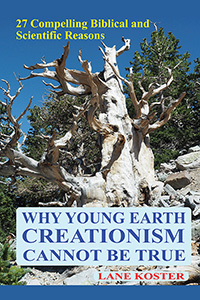
HARMONIZING BIBLICAL TEACHINGS WITH GOD’S CREATION
Debate over the age of the earth has persisted in Christian circles for over 200 years. One view that gained prominence, especially since the 1960’s, is Young Earth Creationism. Does this view stand up to biblical and scientific scrutiny? The purpose of this book is to show there is a better way to understand God’s amazing Creation than the interpretation that God created the heavens and the Earth in six 24-hour days 6000 years ago. This book presents 27 biblical and scientific reasons why this cannot be true. As Christians we want to honor God and be true to His Word. Let us examine the Young Earth claims to see if they stand up to evidence found in both the Bible and Creation. The Bible makes it clear in Psalm 90 that God views time differently than we do. One thousand of our years are like yesterday to God. After God created the heavens, and the Earth to the point where it was “formless and void,” God then took six of His days to complete His work on the Earth. How long did God take between when He began the Creation and when the Earth was “formless and void?” The Bible doesn’t say, but it could be any length of time. Genesis 2 tells us that more happened between when God created Adam and when God brought Eve to Adam than can fit in one 24-hour day. A study of light shows it is not possible for light to reach us from distant stars and galaxies if the universe is only 6000 years old. Noah’s Flood 4500 years ago (as Young Earth Creationists claim) cannot possibly explain all the sedimentary rock, fossils, layers of ice, layers of lake sediment, the Grand Canyon, and many other features we find on Earth. Bristlecone Pine trees are older than Creation, and grow on mountains that did not exist until after Noah’s Flood, according to the Young Earth view. The claim that God made everything to appear older than it really is (the Appearance of Age argument) does not stand up to scrutiny. Nor does the view that God meant for all animals to live forever before Adam and Eve sinned. We do well to examine these claims, so that we can be more effective in sharing the Christian Gospel with people around us.