


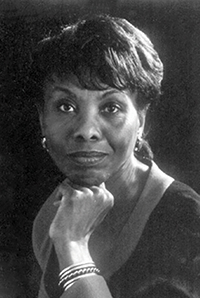
Merelyn B. Bates-Mims, Ph.D, is a university-trained Comparative-Historical linguist who grew up in Southwest Louisiana, in the heart of Creole country, speaking Louisiana Creole English (LCE). She received a Fulbright Scholarship enabling linguistic research and inquiry by consulting with scholars of language and culture at four universities in Africa: the University of Yaoundé; Université de Côte d’Ivoire; Fourah Bay College-University of Sierra Leone; and the Université de Dakar. Owing to the broad perception that Creoles and Pidgins are ‘deviant substrate versions of superstrate European languages,’ i.e., French and English, her curiosity about the origins of Creole and ‘Black English’ led her to seek the Fulbright during her PhD studies at the University of Cincinnati in Ohio. “What language could be said to be the Proto of Africa-descendant languages like Gullah, Creole, Krio, Pidgin, and Black English?” Seeking answers, she was allowed first-hand immersion in the cultures, the ethnographies of various Africa-Continent peoples and nations: Their beliefs, customs, practices, and social behaviors—collecting comparative language samples and many books on language, culture and history as she went along, gratefully living in the intimacy of various families, homes, and communities—an unforgettable experience for which she is eternally grateful. Rather than by means of ‘translations’, it is through ‘transliteration’, i.e., up-down/horizontal word-to-word matchings that ‘proto’ cognition is made evident—out of which descendant families of language forms emerge. Transliteration methodology reveals semantic constructs or word-meaning matches between (among) languages. It is the visual method widely used in this publication to reveal the proto-Africa forms apparent to origins of creole/pidgin languages: TransAtlantic Africa grammars. To avoid future performances of the errors indicative of the 2019 SAT scandal, the linguistic paradigms of Standard Textbook English—beginning with the basic ability for correct sentence matchings of subjects and verbs coupled with mastering the language of mathematics—must be in the firm grasp of every student by the end of 6th grade—before students reach their final years of compulsory education. Community churches, historical bulwarks for establishing education systems, e.g., HBCUs, for black communities across the nation, should also join in singing ‘Teaching of Textbook English’ refrain.
CREOLE COUNTRY
TransAtlantic Kindred Grammars
by Merelyn Bates-Mims
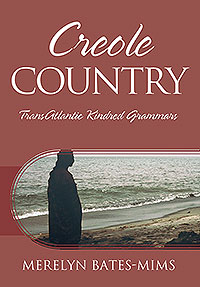

CREOLE COUNTRY
TransAtlantic Kindred Grammars
by Merelyn Bates-Mims
Published Nov 30, 2019
248 Pages
6 x 9 Black & White Dust-Jacketed Hardback
Genre: SOCIAL SCIENCE / Anthropology / Cultural & Social