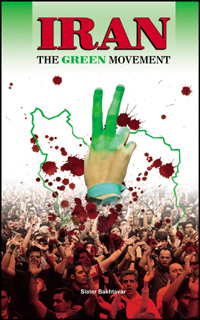
Iran: The Green Movement

by Slater Bakhtavar

Iran: The Green Movement
Pinterest

Iran: The Green Movement

by Slater Bakhtavar

Published Nov 28, 2009
254 Pages
5.5 x 8.5 Black & White Paperback and 6 x 9 Black & White Casebound
Genre: POLITICAL SCIENCE / General


    Find eBook/audiobook editions or buy the paperback or hardback at:

  • Looking for Kindle/Audio editions? Browse Amazon for all formats.
    Searching for the Nook edition? Browse Barnes & Noble.
 

Book Details

Detailing the Movement for Democracy in Iran

At 8:00 am Iranian media announced that 18 million votes when to Ahmadinejad and 9 million went to Mousavi. About 250,000 votes each went to the other two candidates, Mehdi Karroubi and Mohsen Rezai.


Protestors against the success of Ahmadinejad and those celebrating that victory poured into the streets. Intense demonstrations brought the Iranian police who used batons and tear gas to stop the clash that followed. Demonstrators declared Ahmadinejad stole the election. It was reported that at least one person had been shot in Vanak Square in Tehran and automobiles were overturned and burned in the street.


Mousavi stated that he rejected the election results and encouraged supports to fight them but he also urged them to be calm and patient. He did not appear the rest of the day and many thought he may have been arrested. Ayatollah Khamenei did not give heed to pleas for intervention or appeals. He just congratulated Ahmadinejad and asked the other candidates to give him their support.


More demonstrators took to the streets of Tehran during the afternoon. Women, youth, students and members of the moderate clerical establishment took to the streets in the thousands chanting and wearing the bright green campaign colors of Mousavi. Tehran wasn’t the only city seeing this kind of unrest. Because of the activities universities were closed, cell phone transmissions remained blocked and many websites were shut down for a second day.


Book Excerpt

A New book detailing the movement for Democracy and Human Rights in Iran. "This was by far the largest street protest and demonstration in the history of Iran since the 1979 Iranian Revolution. The hundreds of thousands of upset supporters of the defeated reform candidate Mir Hussein Mousavi marched the streets of Tehran and other cities, defying the official protest ban. Mousavi appeared for the first time in public at a rally staged by his supporters in Tehran after the landslide election win of Ahmadinejad, in the hope of calming the now-growing demonstrations.


What some hoped to be a calm protest turned out to be a riotous one as the protesters vented out their frustration and dismay about their candidate’s loss in the June 12th election. In order to quell the protests, the Iranian security forces and the uncompromising militia continued to act with force and arrest the protesters, causing them to revolt further. The revolution only led to the supporters’ incurring of injuries from the beatings of the government’s militia. Brothers’ blood was shed on the streets of Tehran as the rioters fought back and the militia fired guns from rooftops.


Iran’s supreme leader and most powerful figure, Ayatollah Ali Khamenei, drew a hard line that posed as a ploy for Iran’s opposition protesters to either halt any further protests over the June 12th disputed election or risk a violent crackdown. Ayatollah Ali Khamenei issued this warning during his stern sermon in Tehran. He warned the protesters and opposition leaders that they would be held personally responsible if the street protests did not end.


Uncompromisingly, Khamenei told the protesters to drop their demands for a new election and insisted that last week’s presidential votes had been transparent. He said that the Islamic Republic does not alter vote counts as the system does not allow cheating. At the end of the sermon, Khamenei added that if the protesters will not obey and still pursue protesting, he will unleash the military force. Khamenei’s warning seemed to not have any effect because shortly after dusk, cries of “Allahu Akbar” and “Death to the dictator” were shouted from the rooftops as the protesters began their first sign of resistance." -Slater Bakhtavar, Chapter 13.


 

About the Author

Slater Bakhtavar

Slater Bakhtavar, an Iran native, is a published journalist, policy analyst, and practicing attorney. His interest in politics has enabled him to contribute his knowledge to several journals, magazines, and nationally syndicated talk shows. Additionally, Slater is actively involved in analyzing foreign policy for various organizations.

Slater has earned a Bachelor’s Degree in Political Science from Kennesaw State University, a Juris Doctorate Degree from South Texas College of Law, and a LL.M in International Law from Loyola Law School. In addition, Slater Bakhtavar received a certificate in alternative dispute resolution from the University of Georgia Law Center